Stay connected. Subscribe today.

Showing posts with label treatment plants. Show all posts

Monday, November 28, 2016

WATCH: Reading Rainbow's visit to a sewage treatment plant reminds us how awesome LeVar Burton is


If you watched Reading Rainbow as a kid, or if you're still tuned in to today's incarnation of the PBS classic, then this episode proves the theme song's line, "I can go anywhere."

Host LaVar Burton takes a trip to and through a wastewater treatment plant. And while some technology showcased here differs slightly from how we operate in Cleveland, the process is largely the same, and the result is clear, fresh, safe water.

But you don't have to take our word for it.


Friday, October 7, 2016

WEATHER: Do Great Lakes have storm surges?

Storm clouds move across Lake Erie behind our Westerly Wastewater Treatment Plant. Nick Bucurel.
When waterborne natural disasters like hurricanes affect the coasts, one of the biggest threats is not the wind. It's the storm surge.

The surge is the dramatic rise of sea levels and wave height along a coast ahead of the hurricane. While a hurricane is an ocean phenomenon, do the Great Lakes have storm surges? The answer is yes.


Lake Erie and its sister Great Lakes' storm surges are also referred to as seiches, changes in water levels and movements caused by storms. They can be dramatic but without the surge warning that precedes hurricane events.

Michigan Sea Grant reports one of the greatest reported seiches was in Lake Michigan in 1956 when lake levels jumped 10 feet so unexpectedly that beachgoers had to run for safety.

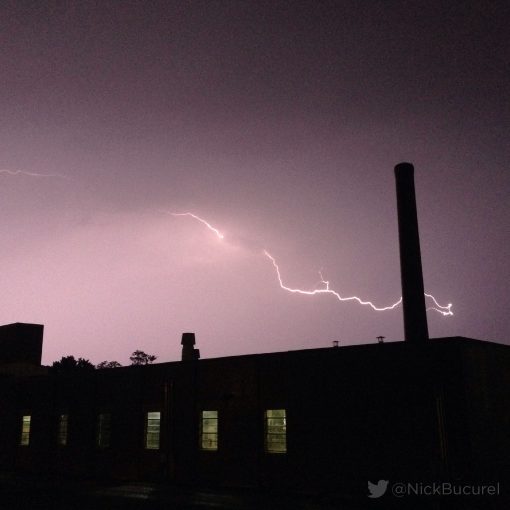
Lightning streak behind Easterly Plant.
Wastewater treatment facilities like ours sit right along the Lake Erie shoreline. Could they be affected by a seich? Not likely. Most storms across Lake Erie blow from west to east, the same direction as the orientation of our lake. That means the eastern and western ends of the lake are more susceptible to the large-scale sloshing of the lake water levels.

Still, rain has a major effect on wastewater treatment systems (especially in older cities like Cleveland where sewage and stormwater flow in the same sewers) and regional stream networks.

Monday, August 8, 2016

SPORTS: What would happen if Michael Phelps tried swimming in our tanks?


As swimmer Michael Phelps places more gold medals around his neck during these Olympic Games in Rio, we wondered how he'd fare in an environment more unusual than a 50-meter chlorinated pool.

Southerly first-stage aeration tanks
Could Phelps swim in one of these long bubbling channels known as an aeration tank? or perhaps the round in-ground-pool-like tanks nearby?

First, such a thing would not be a good idea, and the topic is not an invitation to try it. But second, the hypothetical does make for interesting discussion regarding the treatment process and the water's physical properties.

We asked our Easterly Wastewater Treatment Plant Assistant Superintendent Dan Smith that question, turning our attention to two tanks along our common tour route: our clarifiers, and our aeration tanks.

Monday, February 15, 2016

OUTREACH: Educational roadshows coming to a community near you this spring


Over the next five years, the Northeast Ohio Regional Sewer District is making a huge investment in Greater Cleveland.

Whether it’s tunnels, sewers, pump stations, stormwater solutions or green infrastructure, we are making improvements to keep our Great Lake great.

To help our ratepayers understand what this investment means to them, we will host meetings throughout our 62-community Service Area. Representatives will be available to discuss a variety of topics, including:


All are welcome. UPDATE April 5, 2016: Communication prior today may have included different dates. The information below is the latest.

Thursday, May 19
Nordonia High School
5:00-7:00 p.m.
8006 South Bedford Road
Macedonia

Wednesday, May 25
Tri-C West Campus
5:00-7:00 p.m.
11000 Pleasant Valley Road
Parma, Ohio 44130
B Atrium in Building B

Saturday, June 4
Tri-C East Campus
9:00 a.m.-Noon
4250 Richmond Road
Highland Hills, Ohio 44122
Student Services Building / Presidents Plaza

Wednesday, June 8
Tri-C Metro Campus
5:00-7:00 p.m.
Jerry Sue Thornton Center
2500 East 22nd Street
Cleveland, Ohio 44115
Ford Room

VIDEO: How are rates determined? / Download a PDF

Monday, January 4, 2016

LIST: 5 ways the end of another Browns season is like treating wastewater


The Cleveland Browns' stadium has 85 restrooms, and we have treated their wastewater every year since their return in 1999. It gives is a unique perspective on the team's foundation, and we found five parallels between the end of another season and the work it takes to clean very dirty water.


The last thing you see is messy.
This season was the fourth straight in which the Cleveland Browns played its final game starting a third-string quarterback. And it ended messy. In water terms, once the water has been used at your homes—for washing, bathing, or flushing—it's dirty, and you want to get rid of it. Flush it, forget it, and move on. You can trust us to take it from there.

Despite the temptation, there are things you shouldn't flush.
The recurring desire to flush your tickets, quarterback jerseys, or dreams for championships may be strong, but don't do it. There are things on our "Do not flush" list for a reason. Stay strong and make the right decisions.

Improvement is a process.
Browns owner Jimmy Haslam was quick to say after Sunday's game that there would be change, and there is no such thing as a quick fix. Changing sewage into clean water is no quick-fix either. But one good thing about our process is it takes about 24 hours, considerably less than a search for a GM and head coach.

Is your money going down the drain?
Long-time Cleveland sports fans regularly scratch their heads in despair, asking "What are we getting for our investment?" We know customers may ask the same thing when they pay their sewer bills, which is why we offer our social media accounts, annual Open House, Infrastructure Week, and more to help answer those questions. Your sewer bill is money down the drain in a way, but it's an investment in a system that ensures a Great Lake, something you can believe in well beyond football season.

The cycle continues. 
The water cycle, much like the Cleveland coaching cycle, goes on and on and on and on and on. We have faith in a Browns turnaround. If a river can catch fire 13 times and come back from that, maybe "next year" will be here sooner than we think.

Photo by Erik Drost – Creative Commons License

Thursday, December 17, 2015

WATCH: When we sense a disturbance in the Force, things tend to get messy. #StarWars


We don't think this is the Force George Lucas or J.J. Abrams had in mind. Still, clean water wouldn't be the same without it.

Our own treatment-plant Jedi Christen Wood shows us how force and the rarely-seen sludge "explosion" helps keep a sewer line clear and gives the Death Star's demise a run for its money.

RELATED STORIES:

Friday, November 27, 2015

VIDEO: @Sewer_Chic's report from our Southerly plant shows there are no holidays off


Your toilet can't take an extended holiday. Which is one of many reasons our shift workers like Christen don't either.

Christen Wood is an Operator at our Southerly Wastewater Treatment Plant and she was working on Thanksgiving with a number of her colleagues. She sent us this video after dinner, not only thanking her own family and co-workers who live the shift life, but thanking you, our customers.

We're proud to serve you all year long, holidays, weekends and snow days included.

RELATED STORIES:

Thursday, November 5, 2015

LIST: 5 things you'll learn following our #SewerU November 10


We're hosting our first-ever Sewer University (SewerU) presentation to a capacity crowd of nearly 120 guests on November 10, and if you haven't registered, you'll be able to follow the discussion on Twitter @neorsd #SewerU.

The goal is to bring the underground and often misunderstood sewer network and its function to the surface to better explain how our lives are affected by this critical infrastructure. Here are 5 topics we'll cover that may interest you.

Thursday, October 22, 2015

WATCH: The not-so-terrifying but very creepy-cool tunnels deep under Southerly / #h2olloween


Some of the access tunnels in the bowels of the Southerly Wastewater Treatment Plant in Cuyahoga Heights date back to the plant's grand opening in 1928.

Operator Christen Wood took us for a quick tour of the sprawling and sometimes spooky underground system, just in time for Halloween.

Wednesday, September 30, 2015

ACTION: Start a movement. Join your voices and #RespectTheFlush


Give your drain the acclaim it deserves.


Every time you flush a toilet, drain your sink, or pass a manhole cover along the curb, amazing unseen things are happening that protect public health and the environment. What can you do to show you #RespectTheFlush?

To raise awareness of the value of our water resources, the Value of Water Coalition imagines a Day Without Water October 6-8 across the country. To complement that, one can not overlook the importance of the gray and green systems in place protecting them.

How do you Respect The Flush? Here are 5 simple ideas.


Don't flush wipes.
Disposable wipes are convenient, but they wreak havoc on sewer systems and damage equipment in treatment plants. Throw your baby wipes in the garbage instead of flushing them. And while you're at it, the same goes for the rest of the things on this list.

Tuesday, September 22, 2015

NEWS: CLEvsPIT rivalry, @neorsd faced @alcosanWWTP and clean water was the winner

Open House attendance increase tops 228% over last year as two sewer districts compete in Open House visitors, social media

Mark the Mad Scientist amazed guests at Saturday's record-setting Open House.

With the help of our 1,725 guests last Saturday, the Northeast Ohio Regional Sewer District flushed Pittsburgh! Attendance at the 8th Annual Open House was 228 percent higher than last year's, sweeping the 5.12 percent attendance boost by Alcosan (the regional sewer district in Pittsburgh).

A friendly contest was held between the two agencies to determine which event, both held on the same day, would draw higher attendance numbers. The results came in Tuesday, and both utilities had numbers to be proud of.

  • Northeast Ohio Regional Sewer District
    • 2014: 525 attendees
    • 2015: 1,725 attendees
    • Percentage increase: 228% (Greatest increase)
  • Alcosan
    • 2014: 1,915 attendees
    • 2015: 2,013 attendees (Highest attendance)
    • Percentage increase: 5.12%

Tuesday, September 1, 2015

EVENT: You really gotta go. To the #neorsdTOUR Open House September 19


If urine need of a fun, free, family-friendly event, then you’ve really gotta go. To the Sewer District’s annual Open House.

On September 19, the Sewer District will open its doors to the public to answer the question, "Where Does It Go?" Be there.

At the Open House, guests will have opportunities to tour the Southerly Wastewater Treatment Center—the largest treatment plant of its kind in the State of Ohio—and conduct experiments with Mark the Mad Scientist in the laboratory. Explore the soon-to-debut Sewer Simulator, and sit behind the wheels of our work trucks.


Thursday, August 20, 2015

WATCH: Christen and Ryan's two-minute tour shows you what happens after the flush


How do you take 280 acres of tanks, towers, and tunnels, and a process that takes more than 24 hours from start to finish, and trim it down to less than three minutes?

Christen and Ryan give it a try.

Ryan Melton and Christen Wood are operators at our Southerly Wastewater Treatment Plant in Cuyahoga Heights, and they wanted to give folks an intro to the work it takes to turn sewage into clean, safe lake water.

Pay attention. They move quick, but by the end, they give viewers three key steps in the wastewater treatment process.


Wednesday, June 17, 2015

GRIT: The @Cavs had it, but what is it? #ALLinCLE

Photo via @ridgej

Despite The Plain Dealer's headline June 17, we believe the Cavs had grit all playoffs long. But if they're looking for more heading into next season, we have plenty.

In sports, grit is toughness, attitude and heart. In the clean-water industry, grit is different but it's a major part of the wastewater treatment process. As wastewater flows into the treatment plant, it is slowed down in large tanks that allow solid particles like sand and gravel to settle out. Those settled abrasive particles, known as grit, are removed to ensure equipment runs smoothly.

Here's a closer look.

Wednesday, June 10, 2015

EVENT: 288-acre treatment plant transformed into 5K course for wellness, charity #cwc5K

Top male finisher Anthony Raimondo and female finisher
Bella Renaticello
Dozens of runners turned a wastewater treatment plant into a 5K course June 6 and the sights, sounds, and smells of the summer day made memories for all who attended.

The third annual Clean Water Classic 5K, a wellness event and Charity Choice campaign fundraiser, wove its way through the Southerly Wastewater Treatment Plant in Cuyahoga Heights.

The top male finisher was Anthony Raimondo and the top female finisher was Bella Renaticello who each took home toilet-shaped trophies, because of course they did. See the complete list of runners' times.

More photos after the jump.

Thursday, May 28, 2015

PHOTO: Kids write the darnedest things.


When kids start clearing their desks at the end of the school year, parents never know what to expect.

We were sent a photo of kindergartener Nicholas' worksheet about the five senses, and we know for a fact our plant operators can relate to his sense of smell. Chances are his teacher gave him either an A, or an "Ew."

Related stories:

Tuesday, May 26, 2015

WATCH: What a 5K course through a wastewater treatment plant looks like. #cwc5k


On a 280+ acre swath of land in Cuyahoga Heights sits a series of tanks, tunnels, troughs and trails that help clean tens of billions of gallons of water each year.

It's also the site of the Clean Water Classic 5K.

Each year, we host the #cwc5k to promote wellness and support the Charity Choice campaign benefiting local charities. If you haven't participated before, the video above is the high-speed view of the course runners face the morning of the race.

The choice of music flowing through your ear buds that day however is up to you.

Thursday, May 21, 2015

RECAP: "It's kind of amazing what exists under a manhole cover." #FollowTheFlow


In a whirlwind of scents, sludge, and sights seen by few other eyes, Infrastructure Week last week allowed visitors and followers an underground behind-the-scenes look at the sewers that help make clean water possible.

"It's kind of amazing what exists under a manhole cover," as WCPN's Anne Glausser put it as she peered down the century-old depths of a brick-and-mortar sewer line. And those are the reactions our #FollowTheFlow events were designed to inspire.


Monday, April 27, 2015

EVENT: Go underground and behind the scenes as we #FollowTheFlow during Infrastructure Week May 11


"Go with the flow" has a meaning of its own. "Follow the flow" is going to get a little more interesting.

May 11-15 marks the third year for Infrastructure Week, a national celebration of country’s infrastructure systems and the essential role they play in our economy. To celebrate Infrastructure Week 2015, the Northeast Ohio Regional Sewer District is planning a week-long series of behind-the-scenes tours for local media and elected officials, and you can #FollowTheFlow with the Sewer District all Infrastructure Week long and trace wastewater’s path from the sewer system to Lake Erie.

Here's what we're planning and we'll be covering it all week long on Twitter, Instagram and Periscope.

Thursday, March 26, 2015

NEWS: Could sewage be mined for gold? May also be great excuse to grow awesome beards.


Could human waste really be a source of valuable metals? Recent studies have shown potential, but realizing said potential is still a long way off in all likelihood.

The Huffington Post reported on a study that said human waste may be filled with microscopic particles of gold, silver, platinum, and copper, not to mention several other "nuisance" metals like lead.

More specifically, if these particles—measuring less than 1/100th the width of a human hair—are in human waste or at least entering the sewer system by other means, then they'd eventually make their way to wastewater treatment plants, according to studies, and could thereby be harvested for possible reuse, reduce the needs for mining, and also benefit the environment.

Working where we do, we asked a few of our experts.

"While it's an interesting idea," said our Westerly Wastewater Treatment Plant Superintendent Frank Foley, when asked if there was any chance we could be sitting on a literal gold mine in our collection system, "I’m not sure if we currently have information that would allow us to quantify the amount of precious metals in our ash."

Westerly Wastewater Treatment Plant, Cleveland
Ash is the byproduct of the incineration that manages the "biosolids," organic materials left over from the wastewater treatment process.

He continued: "Another key, stated in the articles is that there would be a cost to extracting the metals from the ash. That would also have to be quantified to determine if it would be worth attempting to recover any of the material." Research presented in Denver this week said the recovery of these metals using current technology "may not be commercially viable."

Translation: Waaaaay too expensive.

Precious metals like these are not in our treatment plant permit limits, says Senior Environmental Specialist Elizabeth Toot-Levy, so we don't monitor for them. That makes an assessment more difficult. And while we do monitor industries like plating companies to make sure they are not discharging metals to the waste stream, one we have spoken to in the past about gold plating stated it takes extra precautions to ensure that their precious products are not flushed away.

So could sewage be a future source of the metals that make their way into our cell phones and computers? Time and further study will tell. In the meantime, we'll keep our eyes on what does flow into our plant, because you never know what you'll find.