Stay connected. Subscribe today.

Monday, July 2, 2012

STORMWATER: Program gets the green light, will begin January 2013

The Sewer District's regional stormwater management program has the green light.

On Thursday, Judge Thomas J. Pokorny issued a final ruling on the Sewer District's regional program to tackle Northeast Ohio’s flooding, erosion, and water quality problems.

The Sewer District will formally implement the Regional Stormwater Management Program in January 2013 and detailed planning for early-stage projects is already underway. The Regional Stormwater Management Program will address flooding, streambank erosion and water quality issues throughout much of Northeast Ohio.


Saturday, June 30, 2012

TRAFFIC: West 11th to close for construction July 9

Starting July 9, West 11th Street will close for about a week to complete a sewer relining project. The street will be closed to all traffic besides local residents.

The relining process, known as cured in place pipe, uses a resin which yields odors. Embedded below are a brief project description and frequently asked questions regarding the resin.


Friday, June 29, 2012

RADIO, part II: "That's a significant drop." Yes, he is.

So when a caller to the WMMS 100.7 Alan Cox Show during Wednesday drivetime reacted to the hosts' conversation about Lake Erie's poor beachwater quality, he rightfully touched on the Sewer District's multi-billion-dollar program to fix some of the problems plaguing the lakefront.

We heard about the call yesterday morning, and our own Jean Chapman sent Alan Cox an email to clarify a few points the caller made. Why not, right? With that, we also used her email as a blog post, embedded a clip from the show's podcast, and added a few points for good measure. In good fun, our spokesdrop Wally tweeted @alancoxshow to let him know he gave us good material and an opportunity to share information.

Then came Thursday's show. Check it out.

Thursday, June 28, 2012

RADIO: I'm not sure we can use that in a headline.

The phrase "t_rd reduction" might be awkward in a headline, but it's the way yesterday's beach report and our efforts to monitor and improve water quality came up in drive-time talk radio yesterday. Hear for yourself:


WMMS's Alan Cox Show spent a few segments on the topic yesterday afternoon. And while Lake Erie and its water quality are the punchline for easy jokes [insert burning-river humor here], we have reduced many pollution sources affecting our lake in the last 40 years.

Yet we are the first to admit we have a long way to go. There are many factors involved in the bacteria and pollution along the lakefront, and we're tackling them.

Wednesday, June 27, 2012

PUP: Picking up waste, dropping some knowledge

Photo by J. Quinn
Summer days and dog walking go hand in hand. On your walks, have you seen any of our PUP signs? The requests for them continue coming in, but so do the questions about the real motivators behind this successful campaign.

Our Pick Up Poop! (PUP) program comes down to two things: Water quality, and common courtesy.

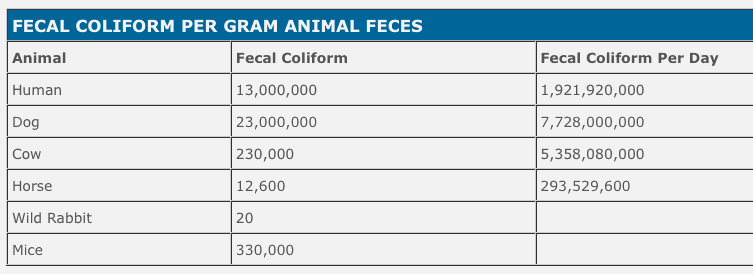
The bac facts: Bacteria Tallahassee (Florida)'s "Think About Personal Pollution (TAPP)" runs a similar pet campaign, and they offer a helpful comparison between the amounts of bacteria in various animal wastes.


TAPP goes on to explain:
Dogs present a special problem. Built to eat almost anything, dogs have as especially large number of intestinal bacteria to digest that wide variety of food, about 23 million bacteria per gram of waste.
Due to dogs' high-protein diets, their waste is highly acidic. It is not a fertilizer and can contain 10 times as much fecal coliform bacteria as cow manure, and also a whole lot of nasty stuff like e. coli, salmonella, and giardia.

Tuesday, June 26, 2012

BEACHES: Sewer District partners with NRDC in press conference on beach quality

Villa Angela Beach in Cleveland, Ohio. Photo by Michael Uva.
Updated 2012 06/27—This morning, the Natural Resources Defense Council (NRDC) held a 10:00 press conference at the Great Lakes Science Center to release its annual report on national beaches—including several in Greater Cleveland—and the Sewer District has partnered with them at the release event.

You can follow tweets from the conference on our @wallywaterdrop Twitter stream or using hashtag #2012beach

Monday, June 25, 2012

PROFILE: Students travel the ins and outs of Cleveland's water cycle

Assistant superintendent Dan Smith speaks to a group of Sewer District summer students and co-ops from a point high atop a trickling filter at the Westerly plant in Cleveland.

Think of it as a water-cycle/career-prep roadtrip. The Sewer District calls it success@work.

The District recently dedicated a day to providing its summer students with insight on how to be more successful in the workplace. With that came a closer look into the work of the Sewer District, the urban water cycle, and related career opportunities present in the Greater Cleveland community.

“I didn’t expect too much, but I really got a lot out of it,” said Ryan Stroud, a student at Case Western Reserve University working in a summer position in Building Maintenance. “We got a lot of information about the (treatment) plants and how the water cycle in Cleveland works, but we also got a lot about personal development.”


Monday, June 18, 2012

PHOTOS: Where's Wally? Austria. Sort of.

Former Sewer District summer student Robert Nedrich sent us a few photos of his time in Vienna, Austria. A true validation of the impact we had on Robert, he was quick to see the resemblance between a Vienna water treatment facility mascot and our own Wally Waterdrop, our official spokesdrop.

Here is an example of one of the information panels they had on display:


The panel illustrates one step in the treatment process, the likely equivalent of aeration tanks like these at our Easterly plant in Cleveland where good bacteria feed on germs in the wastewater. The text, translated from German via Google, reads:
This pool is called a revival pool. Quite a lot of bacteria live here and these need lots of air to breathe. Therefore, air is constantly blown. Bacteria purify the water and eat the dirt.
"Revival pool." Great term.