Stay connected. Subscribe today.

Monday, February 9, 2015

GATOR: February 9 was Alligators in the Sewers Day. We did not know this.

Chickasaw, formerly known as Jenni, rescued from Big Creek by our crews in 2012. Photo by George Uhl.

Blogosphere, we have let you down.

Apparently, February 9 was Alligators in the Sewers Day and we had no idea. For this, we're sorry.

The declaration was made five years ago to commemorate the 1935 sighting of an alligator in the sewers of Harlem, New York.

In 2012, one of our crews had a similar experience as they rescued an 18-inch alligator from the chilly waters of Big Creek in Cleveland. It was no urban legend, no unconfirmed reports, but an actual alligator. The gator, now named Chickasaw, has been in the care of Cleveland Metroparks Zoo ever since where she has been an important part of their outreach and education efforts.

Largely, alligators in sewers survives only as urban legend. Should we see any creatures of such zoological significance in our tunnels underground, we'll be quick to let you know.

Consider this date marked on our calendars moving forward.

Here's Newschannel 5's story from the day:

Thursday, February 5, 2015

WATCH: Here's what 62 years of development looks like in 45 seconds


Development affects landscapes and how water interacts with the natural environment.

In this series of aerial images from the Cleveland Metroparks and the West Creek Conservancy, you can see how urban development has reduced the amount of green space across the West Creek Watershed since 1951.

Increasing hard surfaces like streets and rooftops increases the amount of stormwater runoff that discharges to local waterways like West Creek. That runoff increases the velocity, toxicity, and volume of water which leads to erosion and bank instability.

The award-winning Cleveland Metroparks Watershed Stewardship Center at West Creek in Parma offers programs and resources to help residents learn how they can manage stormwater at home and in their neighborhoods to reduce the regional impacts of stormwater runoff.

Friday, January 30, 2015

#SewerBowl: Who did our K9 Storm pick to win this year's Super Bowl?


Our K9 Storm makes his Super Bowl XLIX prediction: Pats or Seahawks? It's our latest #SewerBowl promotion. Follow us on Instagram, Twitter, and Facebook all weekend long leading up to and during the big game for the latest water and sewer stats about the Super Bowl.

RELATED STORIES:


Wednesday, January 28, 2015

HISTORY: Thank you, Seth Wheeler, inventor of the perforated toilet-paper roll

Image credit Neptuul via wikipedia
Because we know you've been wondering, it was all Seth's idea.

The concept of rolled and perforated squares of toilet paper was patented in 1883 by Seth Wheeler.

Prior to Seth's innovation, toilet paper was sold commercially as flat sheets starting around 1857 thanks to Joseph Gayetty.

TP is a convenience many Americans take for granted—69% of Americans, according to Toilet Paper World—and much news has been made recently of the incredible shrinking rolls as companies have begun reducing the size of its squares without adjusting their prices.

The annual sales of disposable wipes have surged to a $6 billion industry in recent years, and the problems they have caused to sewer systems has grown as well. That's because disposable wipes should be thrown away rather than flushed: Wipes do not break down in plumbing and sewer systems as toilet paper does.

Much like Seth's invention, wastewater treatment is often taken for granted. And from an agency that treats 90 billion gallons of wastewater every year, we know that both conveniences deserve a tip of the lid every so often.

Tuesday, January 20, 2015

#SoTU: Three infrastructure nuggets we would not be surprised to hear at tonight's State of the Union

Image credit Wikipedia

In what The Hill calls "an unusual move," the White House has released an overview of the programs that will be unveiled at tonight's State of the Union address.

From tax-code overhauls to expanding broadband internet access, there's not a direct reference to water or sewer infrastructure in President Obama's SOTU highlights so far, but based on recent events, here are three things we wouldn't be surprised to hear.

Friday, January 16, 2015

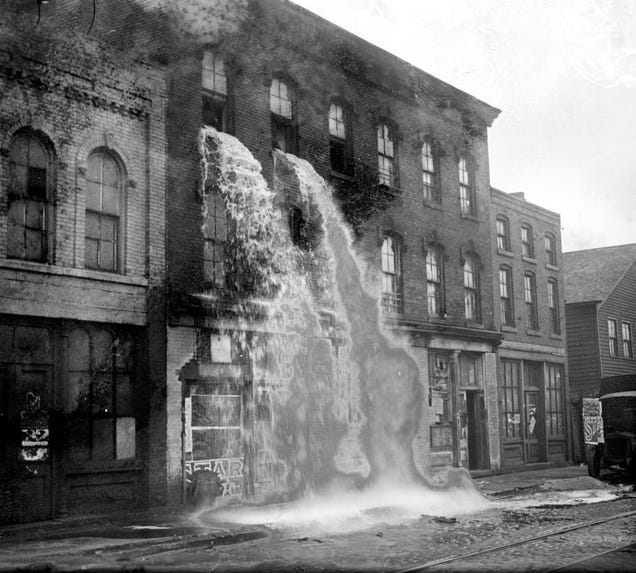
HISTORY: Barrels of alcohol down the sewers? Looking back at 1919 #Prohibition and environmental effects

Image courtesy Library of Congress

Happy anniversary! On this date in 1919, America officially became a "dry" country as prohibition became the law of the land.

Following the ratification of the 18th amendment, there was a whole lotta alcohol that needed to be disposed of around the country, and photo archives show that authorities forced many breweries to drain their inventories. Literally.

Image credit
Image credit
Image credit

Seeing these, we asked our Environmental Services staff: What impact—environmental or otherwise—would this much alcohol have if it entered our sewers all at the same time?

SUPER BOWL: From football to flush, #SewerBowl stats will have you covered again this year


We're covering the big game from the ground up.

For the second straight year, our #SewerBowl team will talk about the infrastructure and sewer news related to the Super Bowl to make connections to the services many Americans take for granted.