Stay connected. Subscribe today.

Showing posts with label history. Show all posts

Wednesday, April 20, 2016

WATCH: Appreciating clean-water history, future is all about keeping it real


We know it's gross, but it's true!

One hundred years ago, the earliest Cleveland sewers were designed to do little more than carry sewage away from the city, discharging it untreated directly into Lake Erie.

Untreated. Right into Lake Erie.

It wasn't until around 1920 that any kind of wastewater treatment began taking shape at the points where sewers met the Cleveland shoreline. And even into the 1960s, pollution and a lack of regulation plagued water quality, until everything changed in 1969.

Besides the shock of hearing gramps say the word "poop," Billy's reaction in the video is common to what we often hear when we talk about the history of clean water in our region. The work it takes to transport wastewater and treat it safely is complicated and costly, but critical. Appreciating our “sewer history” makes the current challenges clearer and opportunities more exciting.

RELATED STORIES:

Thursday, December 31, 2015

HISTORY: This viral list of 1915 facts is full of lies. Except the ones about water.


Turns out this viral list of 1915 "facts" rounding out 2015 is actually a fake, filled with untruths and misleading statements. But FWIW, it turns out the few about water are indeed true.

Gizmodo's Factually posted a breakdown of the list, a graphic that has made its internet rounds back in 2002 and 2006 with very few changes beyond a Photoshopped date. Based on the 1915 fact-checking, the water statements as shown below turn out to be true.

Only 14 percent of homes had a bathtub.
If this is referring to tubs with running water, that's probably true. The Cleveland Division of Water has been around in some form since the 1850s but even in 1915 its service was only beginning to reach beyond the city of Cleveland. In terms of sewers, a primary pipe taking sewage away from the city was not constructed until 1905 (and until a treatment plant was constructed in 1933, that sewage simply dumped out into Lake Erie).

A mechanical engineer could make about $5,000 per year.
Engineering is a huge part of water infrastructure generally, and that's true in our case. For comparisons today, a civil engineer starting annual salary averages $62,000.

Women only washed their hair once a month.
But we assume all of us are washing our hair more frequently in 2016, since on average Americans use 80-100 gallons of water per day.

Diarrhea was one of the six leading causes of death.
Sanitation improvements in the first half of the 1900s made tremendous strides in public health. Around the world, sanitation remains a huge concern: Diarrhea is still accountable for 20% of the six leading causes of child deaths worldwide.

Canned beer hadn't been invested yet.
True, it was not invented until 1935. And when we talk beer, we always say drink responsibly and flush responsibly.

Wednesday, December 30, 2015

#SewerU: Think you know sewers? Get schooled on January 26 at Sewer University


If you are making education part of your 2016 resolutions, this is one event you won't want to miss.

Sewer University presents you with a simple history and future of clean water in the Cleveland area, and the next session is scheduled for January 26 in Cuyahoga Heights. You can register to attend.

Nearly 100 guests joined us in November for our first ever SewerU, and you can watch the full video online. On January 26, Director of Watershed Programs Frank Greenland will cover topics like regional history, sewer types and functions, stormwater problems, green infrastructure and more. Guests will also have an opportunity to tour our award-winning and certified laboratory after the presentation.

Space is limited. Register today.

Thursday, November 5, 2015

LIST: 5 things you'll learn following our #SewerU November 10


We're hosting our first-ever Sewer University (SewerU) presentation to a capacity crowd of nearly 120 guests on November 10, and if you haven't registered, you'll be able to follow the discussion on Twitter @neorsd #SewerU.

The goal is to bring the underground and often misunderstood sewer network and its function to the surface to better explain how our lives are affected by this critical infrastructure. Here are 5 topics we'll cover that may interest you.

Thursday, October 29, 2015

#TBT: Yes, THAT James Earl Jones narrated this 1978 documentary about the Cuyahoga River

The melodious tones of James Earl Jones' golden pipes grace the narration track of this Cuyahoga River documentary from 1978.

This clip features JEJ reading text from an infamous Time Magazine article that followed the 1969 river fire.


Cuyahoga (1978)
#TBT: "Some river! Chocolate brown, bubbling with subsurface gases. It oozes rather than flows." Hear the one and only James Earl Jones read from the 1969 Time magazine article that followed the Cuyahoga River fire.
Posted by Northeast Ohio Regional Sewer District on Thursday, October 29, 2015

Learn more about the 1969 blaze, or the 12 or more other times the river burned.

Friday, October 9, 2015

EVENT: Sewer University #SewerU now enrolling, your 101 course for Northeast Ohio's sewer history and water future

VIEW THE SLIDEDECK. If you missed it, you can register for our next SewerU January 26.
All participants graduate sewer cum laude with a Business major and a minor in puns.

Have you ever wondered where "it" goes in Northeast Ohio? If so, register for our first ever Sewer University (#SewerU) Tuesday, November 10 from 9:00 a.m. to 12:00 p.m at our Environmental & Maintenance Services Center, 4747 E. 49th Street in Cuyahoga Heights [map].

DOWNLOADS: View the slidedeck / Download PDF 
RELATED NEWS: LISTEN: WMMS host Alan Cox loves the idea. Not sure about his #SewerU football team suggestions, though.
This half-day journey into the history of sewers and the future of clean water in Greater Cleveland will take place at the Sewer District’s Environmental & Maintenance Services Center located at 4747 East 49th Street in Cuyahoga Heights [map].

Frank Greenland, Director of Watershed Programs and a 27-year Sewer District veteran, will lead the two-hour discussion and Q&A session, which will include:
  • History of sewers across northeast Ohio
  • Why the river burned many times before 1969
  • How dirty water gets cleaned
  • Stormwater, flooding and monitoring water quality
  • The designs and dangers of sewer systems
  • Infrastructure: Why gray and green matter
  • The costs of clean water and a Great Lake

Thursday, August 20, 2015

MEMORIAL: Louis Stokes' legacy in Northeast Ohio touches environment, infrastructure, education

By U.S. Congress [Public domain]
via Wikimedia Commons
Congressman Louis Stokes was known for many things. While his actions to protect clean water may not be one of them, it should be.

Congressman Stokes, who passed away Tuesday after a battle with cancer, was pivotal in securing Federal funding for Northeast Ohio infrastructure that helped improve and further protect the water quality of Lake Erie.

"Congressman Stokes had an impact on our region that is broad and lasting," said our Director of Administration and External Affairs Constance T. Haqq. "His focus on civil rights and the poor is well known, but our clean-water infrastructure was also something that improved through his influence."

While Chair of the House Appropriations Committee, Congressman Stokes secured more than $60 million in special appropriations in the early 1990s to convert our Westerly Wastewater Treatment Plant from a failed physical-treatment process to a new biological facility.

In 1998, the Sewer District established the Louis Stokes Environmental Studies Scholarship in his honor to provide assistance to deserving Central State University students majoring in Water Resources Management, Industrial Technology, and Environmental Engineering.

Denise Phillips was a Central State University student and a recipient of the Stokes Scholarship. She is currently an Investigator in our Water Quality & Industrial Surveillance department. "The scholarship provided me with the opportunity to intern with the Northeast Ohio Regional Sewer District," she said. "I'm pursuing my career at the Sewer District in a field that I love. This scholarship was life-changing for me and I am so grateful to Louis Stokes for this wonderful opportunity."

"I admire Mr. Stokes' legacy," said Lamar Legrone, a 2011-2013 Stokes scholarship recipient. "His dedication to Cleveland and his role in Congress opened doors for many inner-city students."

Fellow recipient Daniel Peoples (2013-2015) agreed. "Mr. Stokes gave urban youths a much better situation. He will be missed." 

Monday, June 22, 2015

HISTORY: Wait, the Cuyahoga River burned HOW many times before 1969?

Two men wearing life jackets on a small boat on Lake Erie, 1976. Both the boat and the men are covered in oil polluting Lake Erie. Image courtesy of Cleveland State University Library Division of Special Collections.

When the oozing Cuyahoga River caught fire in 1969, consider that it might not have even made the "Top 10" list of Cleveland river fires at the time.

A spark ignited pollution on the Crooked River 46 years ago today—June 22, 1969—but few realize that it actually was the thirteenth time it had happened.

Thirteen times. Take that in for a moment. The river had once been so polluted and abused since the 1860s that tar-black layers of filth burned on its surface on at least 13 other occasions.

Thursday, March 19, 2015

NEWS: Infrastructure "shouldn't be controversial," says President Obama in City Club of Cleveland Q&A


President Barack Obama addressed a crowd of 500 guests at the Global Center for Health and Innovation yesterday, focusing his remarks on the federal budget, middle-class economics and manufacturing opportunities.

But both infrastructure and environmental regulation made it into the President's comments as he welcomed questions from the audience after his speech.


"What has surprised me," said President Obama, when asked what has surprised him most since beginning his first term, "even though I had served in the Senate, was the continued difficulties in Congress getting stuff done that shouldn’t be controversial." He continued:

Wednesday, January 28, 2015

HISTORY: Thank you, Seth Wheeler, inventor of the perforated toilet-paper roll

Image credit Neptuul via wikipedia
Because we know you've been wondering, it was all Seth's idea.

The concept of rolled and perforated squares of toilet paper was patented in 1883 by Seth Wheeler.

Prior to Seth's innovation, toilet paper was sold commercially as flat sheets starting around 1857 thanks to Joseph Gayetty.

TP is a convenience many Americans take for granted—69% of Americans, according to Toilet Paper World—and much news has been made recently of the incredible shrinking rolls as companies have begun reducing the size of its squares without adjusting their prices.

The annual sales of disposable wipes have surged to a $6 billion industry in recent years, and the problems they have caused to sewer systems has grown as well. That's because disposable wipes should be thrown away rather than flushed: Wipes do not break down in plumbing and sewer systems as toilet paper does.

Much like Seth's invention, wastewater treatment is often taken for granted. And from an agency that treats 90 billion gallons of wastewater every year, we know that both conveniences deserve a tip of the lid every so often.

Friday, January 16, 2015

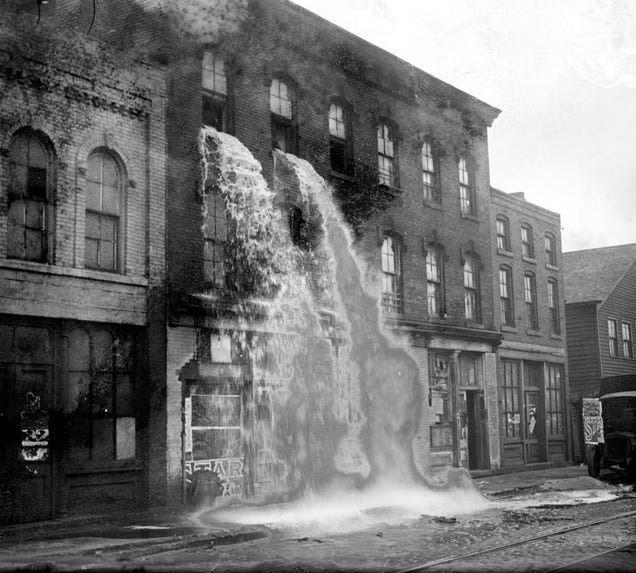
HISTORY: Barrels of alcohol down the sewers? Looking back at 1919 #Prohibition and environmental effects

Image courtesy Library of Congress

Happy anniversary! On this date in 1919, America officially became a "dry" country as prohibition became the law of the land.

Following the ratification of the 18th amendment, there was a whole lotta alcohol that needed to be disposed of around the country, and photo archives show that authorities forced many breweries to drain their inventories. Literally.

Image credit
Image credit
Image credit

Seeing these, we asked our Environmental Services staff: What impact—environmental or otherwise—would this much alcohol have if it entered our sewers all at the same time?

Tuesday, September 23, 2014

HISTORY: Big balls were used to clear sewers of the 1870s

The sewer ball on a vintage postcard. Via delcampe.net

Now that's old school. Cleaning sewers in Paris in the 1870s literally required rolling giant balls of wood and iron through the tunnels.

Atlas Obscura recently posted a story about the history of the world-famous sewer network under Paris, France, including the effort it takes to keep the 160-year-old system blockage free.

Back in the old days (and even in some stretches of sewer today), workers raked muck from sewers that could be reached safely, but some scenarios called for something more. Enter these giant balls of the 1870s. They were forcefully "bowled" against larger blockages to clear tunnels.

Tuesday, July 1, 2014

HISTORY: What were toilets like in 1776?


Whether America is celebrating its founding fathers or its independence, we ask a question about one item most of us are quite dependent upon today:

What were toilets like in 1776?

To understand the privies of the day, it's best to look at the entire state of sanitation overall in the late 1700s.

At the time of the signing of the Declaration of Independence and the American Revolutionary War, sanitation left much to be desired. Disease spread easily, especially among troops in the close quarters of army barracks.

As Edward Park put so plainly:
...eighteenth century troops stank. The citizens of Williamsburg (Virginia) would have smelled pretty ripe, too. It's safe to assume that we would have found the entire Old Dominion—in fact, all thirteen colonies—afflicted with B.O. And since everyone stank, no one noticed it or recorded it for history.

Thursday, June 19, 2014

VIDEO: James Earl Jones describes the 1969 Cuyahoga River fire [#Cuyahoga45]


In this clip from a 1978 documentary, Cuyahoga, James Earl Jones' booming voice tells the tale of the famous 1969 Cuyahoga River fire that turned national attention on the state of our environment and inspired action in Northeast Ohio and far beyond.

Thursday, June 12, 2014

HISTORY: How a dying river saved our lives.

Two men wearing life jackets on a small boat on Lake Erie, 1976. Both the boat and the men are covered in oil polluting Lake Erie. Image courtesy of Cleveland State University Library Division of Special Collections.

When the oozing Cuyahoga River caught fire in 1969, consider that it might not have even made the "Top 10" list of Cleveland river fires at the time.

A spark ignited pollution on the Crooked River on June 22, 1969—but few today realize that it actually was the thirteenth time it had happened.

Thirteen times. Take that in for a moment. The river had once been so polluted and abused since the 1860s that tar-black layers of filth burned on its surface on at least 13 other occasions.

Wednesday, April 16, 2014

#TBT: They don't make garden hose advertisements like this anymore.

StateLibQld 1 49792 Advertisement for Dunlop garden hoses

In 1914, Australians apparently took their yard work very seriously.

This ad for Dunlop Garden Hoses as seen on Wikipedia takes us back to a different time in fashion. But it also reminds us of two points relevant today.

First, if you have a lawn or garden and water them regularly, consider rain barrels for water reuse.

Also, if you are a NEORSD customer and homeowner consuming more water in the summer for pools, washing cars, or other uses, you can sign up for our Summer Sprinkling program that may help you lower your bills.

And now, back to 1914:


You're welcome.

Wednesday, February 12, 2014

INFOGRAPHIC: Fossilized feces? What dinosaurs left behind still fascinates. #DinoDoo

Haplocanthosaurus skeletal mount at the Cleveland Museum of Natural History.
Scott Robert Anselmo via Wikipedia.

In our business, there is much to talk about when it comes to our "business." Our bodily functions and trips to the bathroom every day account for much of the flow we treat and release to Lake Erie.

But when unique opportunities arise to educate about the importance of clean water and the sewers that make that possible, we take them seriously.

Even if the phrase "dinosaur poop" does make you snicker.

Thursday, January 30, 2014

GREEN: Our Project Clean Lake agreement was groundbreaking, and here are 7 reasons why.


Project Clean Lake was a groundbreaking agreement in 2010 when we signed it, making our 25-year program to reduce pollution in Lake Erie official. A lot has happened in the last four years and our consent decree is still a groundbreaking agreement for the region and clean-water agencies across the country.

Here are seven reasons why.

Thursday, December 12, 2013

HISTORY: Why are tunnel boring machines named, and why are they named after women?


Yesterday, our tunnel boring machine Mackenzie—who has been disassembled for more than a month but keeps right on tweeting—received a great question from a follower:


With a little help and a link shared by @HMMnews, we were able to find the answer. WNYC's Derek Wang reported earlier this year, covering Seattle's TBM Bertha, that "the tradition and practice of naming tunneling machines dates back to the earliest mining traditions" including devotions to patron saints of safety of underground workers.


Thursday, December 5, 2013

VIDEO: 1928 school film shares how to treat sewage, how to set rat traps, and how not to catch malaria, typhoid, or the bubonic plague


Throwback Thursday is an opportunity to harken back to a time when we used the words "hence" and "typhoid" in daily American conversation.

The 4-minute clip above is from a 20-minute 1928 educational silent film called "Health and Hygiene" which focused on the causes of common diseases and their remedies.